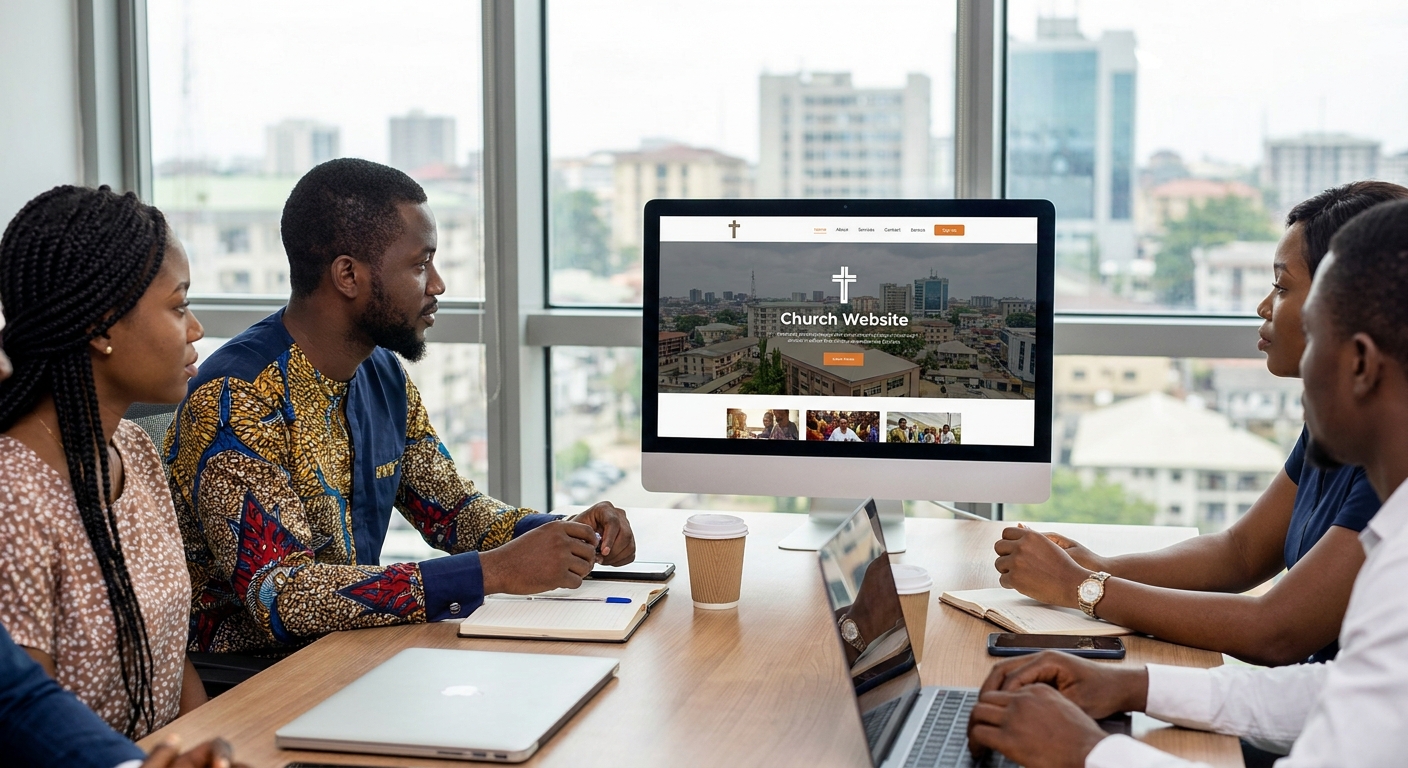
A church website in Nigeria has one job most people miss: get a first-time visitor from a Google search to your front door before Sunday, and get a member from that same phone to giving online after payday. Get the build wrong and both fail by the third month.
- Custom multi-page builds win website design for churches in Nigeria — free templates stall once weekly traffic grows past a few hundred visits.
- Paystack or Flutterwave giving integration is non-negotiable; sites without local payment rails lose online donations outright.
- Mobile load time under 3 seconds keeps first-time visitors from leaving before service times even load.
- Multi-campus churches need branch-specific pages, not one page listing every address and time together.
- Local search visibility for terms like 'church near me' now matters more than a flashy homepage slider in 2026.
Why this matters
Google's own 2016 mobile research found that 53% of visits get abandoned when a page takes longer than 3 seconds to load — and Nigeria's mobile data speeds make that threshold harder to hit than it sounds. Nigeria Communications Commission figures put smartphone-only internet access above 80% of users, which means your church site is a phone experience first and a desktop afterthought, full stop.
A website design built for a US church template rarely accounts for MTN or Glo network drops, Paystack instead of Stripe, or a congregation that finds you through WhatsApp shares, not email newsletters. That gap is where most Nigerian church sites lose visitors in 2026 — not on design taste, on infrastructure fit.
Who this is for
This guide is for pastors, church administrators, and communications volunteers running a Nigerian church — from a single Lagos branch to a multi-campus ministry with services in Ikeja, Abuja, and Port Harcourt — who need a site that handles giving, sermon archives, and service times without a full-time developer on staff.
What to look for in website design for churches in Nigeria
Mobile speed and network reliability
Most of your congregation checks service times on a phone with patchy data, often on the walk to Sunday service. A site that loads in under 3 seconds on 3G keeps that visitor; one that hangs for 8-10 seconds loses them to a WhatsApp forward instead.
Online giving integration
Paystack and Flutterwave are the two payment rails that actually clear for Nigerian churches — PayPal alone locks out members without international cards. A giving page that redirects off-site or times out kills tithes and offerings before they're submitted.
Sermon and media library
Embedded YouTube or Facebook livestreams matter more than a downloadable audio archive for most congregations in 2026, since bandwidth costs still push members toward streaming over large file downloads. A searchable sermon archive by date and topic keeps returning visitors on the site longer than a single homepage video.
Multi-campus service scheduling
Churches running two or more locations need branch-specific pages with distinct addresses, service times, and contact numbers — not one shared page listing everything together, which confuses first-time visitors trying to find the nearest campus.
Local search visibility
Searches like "church near me" or "[denomination] church in Lekki" drive walk-in visitors the same way they drive foot traffic to a restaurant. A site without basic on-page SEO — proper page titles, location pages, Google Business Profile linkage — stays invisible to that search intent no matter how good the design looks.
Top picks for church website builds in 2026
The safe pick — custom multi-page site on a managed CMS. The same structure used for professional website design for law firms in Nigeria applies here: 8-12 core pages, clear navigation, and a CMS a volunteer can update without touching code. Verdict: Buy for any church with more than one weekly service or more than 200 members.
The media-heavy pick — sermon archive with livestream embed. Built around a searchable sermon library instead of a single homepage video, this approach handles growing archives past 200 sermons without slowing the homepage down. Verdict: Buy for congregations that record every service; Consider for smaller churches still building a media habit.
The budget template pick. Off-the-shelf builder templates can go live within a week and cost less upfront, but most cap giving integrations to foreign payment processors and limit custom domains on free tiers. Verdict: Consider only as a short-term placeholder while a custom build is in progress.
The multi-campus pick — one site, branch-specific pages. Built for churches running services across Lagos, Abuja, or Port Harcourt simultaneously, with each branch carrying its own address, time, and contact block. Verdict: Buy for any church with 2+ physical locations.
A custom build also carries visual identity work — logo, color system, typography — the same groundwork used in branding for startups in Lagos, where a consistent identity across print and digital cuts confusion for new visitors fast.
The DIY free-builder pick. Free drag-and-drop builders skip local payment gateways entirely and slap the builder's branding across your footer. Verdict: Skip for any church expecting online giving or a multi-campus structure.
What to avoid
- Generic templates with no local payment gateway — a giving button that only connects to PayPal or Stripe locks out most Nigerian donors instantly.
- Foreign-hosted sites with no local CDN — page load jumps past 5-6 seconds for Lagos visitors when the server sits outside West Africa.
- Autoplay background music or video on the homepage — it adds load weight and pushes bounce rates up before service information even renders.
Comparison across the criteria
| Build type | Mobile speed | Giving integration | Media library | Local SEO | CMS ease |
|---|---|---|---|---|---|
| Custom multi-page (managed CMS) | Strong | Paystack/Flutterwave ready | Full archive | Strong | Volunteer-friendly |
| Media-heavy sermon archive | Moderate | Yes | Excellent | Moderate | Moderate |
| Budget template | Weak | Foreign gateways only | Limited | Weak | Easy but restrictive |
| Multi-campus site | Strong | Yes | Full archive | Strong | Moderate |
| Free DIY builder | Weak | None | Basic | Weak | Very easy |
Build your church site right the first time
Get a build built for Nigerian giving rails, mobile speed, and local search.
FAQ
What's the best website design for churches in Nigeria in 2026?
A custom multi-page build on a managed CMS with Paystack or Flutterwave giving integration is the strongest option in 2026. Free templates and foreign-hosted builders both fall short on local payment support and mobile load speed.
Is a free website builder good enough for a small church?
A free builder works only as a short-term placeholder while a custom site is being built. Most free tiers lack local giving integration and cap custom domains, which limits growth past a small congregation.
How much does giving integration cost to add to a church site?
Costs vary by provider and transaction volume, so check current Paystack and Flutterwave rates directly. The integration itself is a standard build feature on most custom church website projects.
Do multi-campus churches need separate websites for each branch?
No — one site with branch-specific pages for each campus works better than separate domains. It keeps SEO authority in one place while still giving each location its own address and service times.
How fast should a church website load on mobile in Nigeria?
Under 3 seconds is the benchmark, based on Google's 2016 mobile research showing 53% of visits get abandoned past that mark. Nigerian mobile networks make this harder to hit than on faster fixed connections, which is why hosting choice matters.
Does a church website need SEO for local search?
Yes — searches like 'church near me' or a denomination plus neighborhood name drive walk-in visitors the same way local search drives foot traffic for any business. A site without basic on-page SEO stays invisible to that traffic in 2026.
Should a church site include a sermon archive?
A searchable sermon archive by date and topic keeps returning visitors on the site longer than a single homepage video. It matters most for churches recording every service rather than occasional ones.
Can volunteers manage a church website without a developer?
Yes, if the CMS is chosen for that purpose from the start. A custom build with a volunteer-friendly CMS lets non-technical staff update service times and sermon posts without touching code.
One last thing
The detail most church boards skip: giving page abandonment usually happens at the payment redirect, not the amount field. If your giving button bounces a donor to an external page that takes more than a couple of seconds to load, you lose the gift right there — build the giving flow to stay on-domain wherever the payment provider allows it.